Oracle PeopleSoft Archive, Retirement & Historical Access
Retire PeopleSoft Without Losing The History Your Business Still Needs
PeopleSoftArchive preserves secure, searchable, read-only access to historical PeopleSoft HCM and FSCM data after the legacy application stack is retired.
Keep employee, payroll, supplier, voucher, customer, billing, purchasing, inventory, project, attachment, and ChartField history available without keeping PeopleSoft operational forever.
The PeopleSoft Retirement Challenge
Historical access does not disappear when PeopleSoft stops running transactions.
Finance, HR, Payroll, Benefits, Procurement, Audit, Compliance, Legal, and records-management teams still need answers from old PeopleSoft data. The challenge is to preserve the evidence and business context without preserving the full application stack.
For CIOs and IT leaders
Reduce legacy infrastructure, upgrade, patching, and support burden while maintaining a controlled archive for historical reporting and audit access.
For business users
Search historical employees, jobs, benefits, paychecks, suppliers, vouchers, customers, invoices, journals, purchase orders, receipts, inventory, and projects.
For audit and compliance
Retrieve read-only transaction history, supporting documents, payroll forms, attachments, and accounting context through controlled access.
For records-management teams
Keep historical PeopleSoft information discoverable and governed without relying on old menus, responsibilities, integrations, or runtime behavior.
Business Problems We Solve
Retire PeopleSoft infrastructure while preserving historical visibility.
Retire Legacy PeopleSoft Infrastructure
Shut down aging PeopleSoft environments and reduce the cost of keeping legacy infrastructure running only for historical access.
Keep Historical Data Accessible
Give Finance, HR, Payroll, Benefits, Procurement, Audit, Compliance, Legal, and records-management teams continued access to the historical records they still need.
Respond to Audits Faster
Help audit and compliance teams retrieve historical evidence quickly with controlled access to reports, downloads, documents, attachments, and preserved transaction history.
Give Users Self-Service Access
Let business users search historical PeopleSoft data through a browser-based archive without depending on the retired application or routine IT assistance.
Enterprise Deployment Experience
Built for enterprise environments with long-lived HR and financial history.
Experience supporting PeopleSoft historical reporting, audit readiness, records retention, data validation, and cloud modernization initiatives across enterprise environments.
Archival Process
End-to-end PeopleSoft archival and reporting workflow.
Supported Versions
Compatible across PeopleSoft, Oracle Database, and Autonomous Database environments.
Oracle PeopleSoft
Oracle Database
Autonomous Database
Current Archive Coverage
Built for PeopleSoft HCM and FSCM historical access.
The current archive focuses on HCM, Benefits, Payroll, General Ledger, Accounts Payable, Accounts Receivable, Billing, Asset Management, Purchasing, and Inventory. Campus Solutions data exists in the archive foundation, but Campus reporting is planned for a future phase.
HCM
Employees and Jobs
Employee information, job history, name history, absence documents, and related workforce context.
Benefits and Payroll
Pay and Documents
Benefits enrollment, leave accrual, retirement plans, paycheck earnings, payroll checks, deductions, balances, W-2, T4, 1095-C, and payslip XML documents.
FSCM
Financials and Supply Chain
Journals, balances, suppliers, vouchers, customers, billing invoices, assets, purchase orders, requisitions, receipts, inventory items, and inventory activity.
Reporting And Drill-Down Access
Main search pages lead users into transaction details.
Reports are organized by familiar PeopleSoft business modules. Main Search pages link to compact Details pages with related detail reports, while technical IDs and join keys are placed at the end and hidden where appropriate.
HCM and Payroll
- Employee Information and Employee Details
- Benefits Enrollment and Dependents
- Payroll Checks and Paycheck Details
- W-2, T4, ACA 1095-C, and payslip XML documents
FSCM
- GL Journals, Journal Lines, ChartFields, and Balances
- Suppliers, Vouchers, Payments, and Voucher Attachments
- Customers, Open Items, Aging, Payments, and Statements
- Purchase Orders, Requisitions, Receipts, and Inventory
Product Demonstration
See the PeopleSoft archive experience in action.
Watch a walkthrough of historical PeopleSoft archive access, reporting, drill-down navigation, secure documents, and audit-ready inquiry.
Secure Attachments And Documents
Documents are available through validated download paths, not direct BLOB exposure.
Attachment BLOBs are never exposed directly. Secure PL/SQL packages validate that a requested document belongs to the current business transaction or employee before download.
Employee Documents
Absence documents, payslip XML, W-2, T4, ACA 1095-C, and related payroll records.
Financial Documents
Journal attachments, voucher attachments, customer attachments, statements, dunning letters, invoice images, and receivable supporting documents.
Procurement Documents
Supplier, purchase order, requisition, receipt, and related supply chain attachments.
ChartFields And Accounting Context
Preserve the accounting meaning behind historical transactions.
PeopleSoft history is only useful when users can understand the business meaning of the data. The archive preserves ChartFields, account and department descriptions, configurable labels where possible, and read-only reporting views with semantic column names.
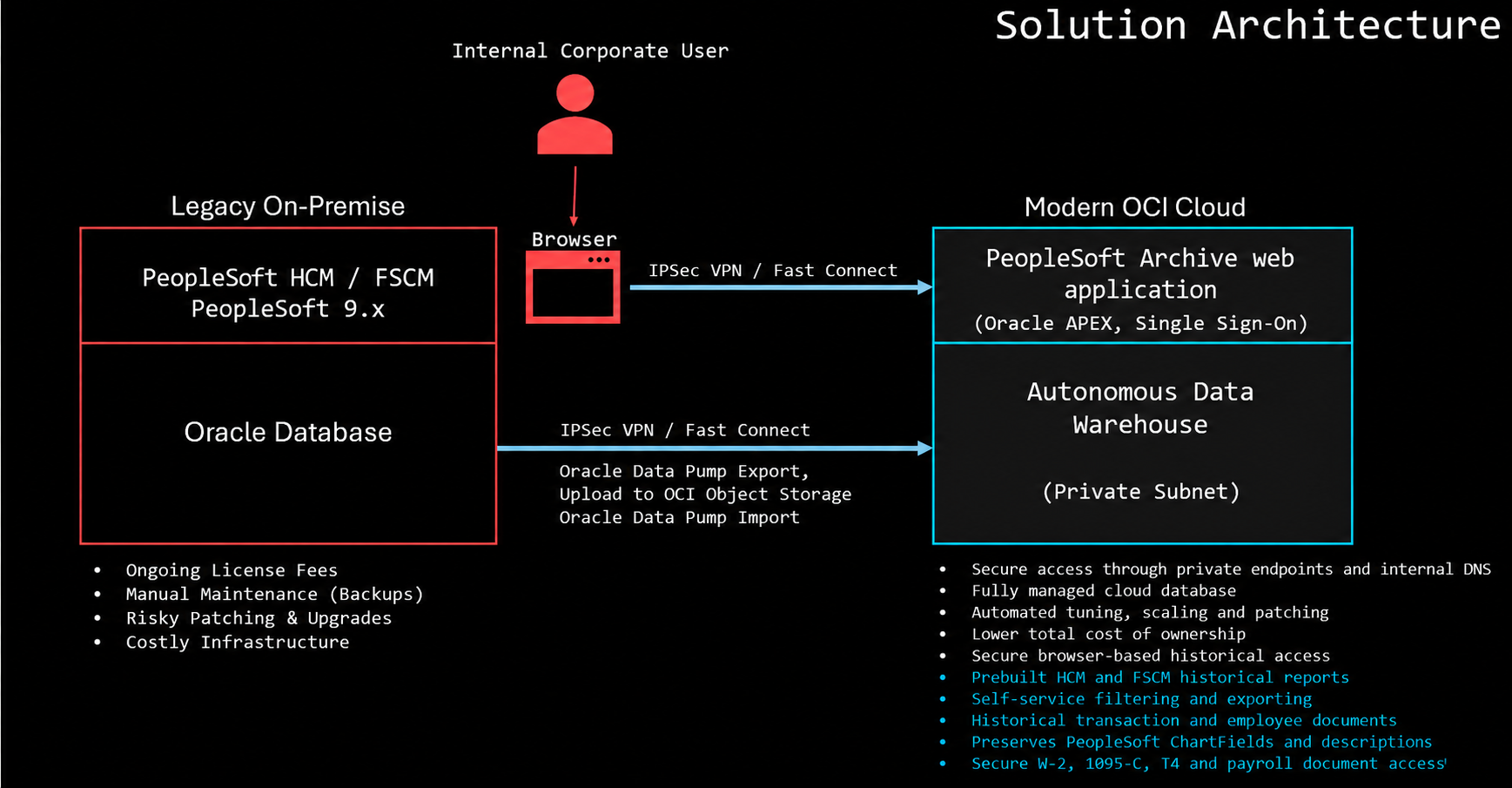
Architecture Overview
A secure archive built on Oracle Autonomous Data Warehouse and APEX.
The APEX parsing schema is PSAPPS and contains synonyms only. Reporting views are owned by PSHCM_SYSADM and PSFSCM_SYSADM. OCI Object Storage is used where applicable for archive transfer and document workflows.
Security And Auditability
Designed for read-only access, controlled downloads, and audit confidence.
Read-only data
Historical tables and reporting views support inquiry and evidence retrieval, not new PeopleSoft transaction processing.
Controlled access
Access can be organized by familiar PeopleSoft business areas and enterprise identity groups.
Validated downloads
Secure packages validate transaction or employee context before returning supporting documents.
Frequently Asked Questions
Common questions about PeopleSoft archival and retirement.
Can PeopleSoft be fully retired after archival? +
Yes, after required history, documents, reporting, security, and validation needs are met. The archive is designed to preserve access to historical data without requiring the full PeopleSoft application stack to remain operational.
What PeopleSoft product areas are covered today? +
Current coverage focuses on PeopleSoft HCM and FSCM history, including employee information, benefits, payroll, General Ledger, Accounts Payable, Accounts Receivable, Billing, Asset Management, Purchasing, and Inventory.
What historical HCM information can users access? +
Users can access employee information, employee details, job history, name history, absence documents, benefits enrollment, dependents, leave accrual, retirement plans, and other approved HCM archive views.
What payroll history is available? +
Payroll coverage includes paycheck earnings, payroll checks, paycheck details, additional pay history, general deductions, deduction balances, tax balances, garnishment balances, special accumulators, year-to-date balances, earnings balances, W-2 documents, payslip XML documents, ACA 1095-C documents, and Canadian T4 documents.
What Financials and Supply Chain history is available? +
FSCM coverage includes General Ledger journals, journal lines, account activity, balances, suppliers, vouchers, payments, customers, transactions, open items, aging, billing invoices, assets, purchase orders, requisitions, receipts, inventory items, on-hand balances, lots, serials, transactions, reservations, and allocations.
Can users export report data? +
Yes. APEX reports can support searching, filtering, drill-down navigation, and exports based on the archive design and each customer's access policy.
Are PeopleSoft documents and attachments included? +
Yes, where in scope. The archive supports secure access to employee, payroll, financial, procurement, receivables, billing, and inventory-related documents through validated download logic.
How are attachments protected? +
Attachment BLOBs are not exposed directly. Secure PL/SQL download packages validate that a requested attachment belongs to the current business transaction or employee before the file is returned.
How are ChartFields handled? +
The archive preserves PeopleSoft ChartFields, account and department descriptions, and related accounting context so historical journals, vouchers, purchase orders, invoices, receipts, inventory transactions, and project costs remain understandable to business users.
Is the archive read-only? +
Yes. The archive is designed for historical inquiry, reporting, evidence retrieval, and downloads. It is not used for new PeopleSoft transaction processing.
What is the application architecture? +
The archive uses Oracle Autonomous Data Warehouse, Oracle APEX, OCI Object Storage where applicable, and read-only reporting views. The APEX parsing schema is PSAPPS and contains synonyms only. Reporting views are owned by PSHCM_SYSADM and PSFSCM_SYSADM.
Request A Demo
Planning a PeopleSoft retirement or historical archive?
Discuss your PeopleSoft HCM and FSCM scope, document requirements, ChartField reporting, security model, retention needs, and retirement timeline.